The Legend of the Green Rat: Driving Steve McQueen’s 1957 Jaguar XKSS in 2026
Steve McQueen. The name itself conjures images of roaring engines, sun-drenched California highways, and an indomitable spirit that defied convention. He wasn’t just an actor; he was an icon, a rebel, a man who lived life in the fast lane both on and off the screen. And at the heart of his automotive legend sits a very special machine: a 1957 Jaguar XKSS, chassis number XK.SS.713, affectionately known to him as the “Green Rat.”
Here in 2026, nearly half a century after McQueen’s passing, the allure of his life and his cars remains as potent as ever. While the Hollywood Hills may have changed, the echoes of those midnight drives and the thrill of the open road still resonate. To sit behind the wheel of this particular XKSS is to step back in time, to feel the raw, unfiltered connection between man and machine that defined an era.
This isn’t just a story about a vintage car; it’s about the intersection of Hollywood mythmaking and automotive purity. It’s about a troubled genius who found solace in the mechanical precision of a race car adapted for the street. And it’s about how, even today, the legacy of the King of Cool continues to inspire and captivate us.
The Complicated Icon: More Than Just a Pretty Face
Before we delve into the mechanics of the Green Rat, it’s crucial to understand the man who made it legendary. Steve McQueen, born Terrence Steven McQueen in 1930, was a walking contradiction. A dyslexic youth who spent time in reform schools and on the streets, he possessed a raw, untamed energy that was both magnetic and terrifying. He could be kind-hearted one moment, explosive the next. He was a perfectionist who drove himself and those around him to the brink.
Yet, it was this very complexity that made him so compelling. In an era of polished movie stars, McQueen was rough around the edges. He was the embodiment of the anti-hero, the flawed rebel we couldn’t help but root for. His steely blue gaze and smoldering intensity translated seamlessly to the silver screen, making him a global superstar in films like The Great Escape, Bullitt, and Le Mans.
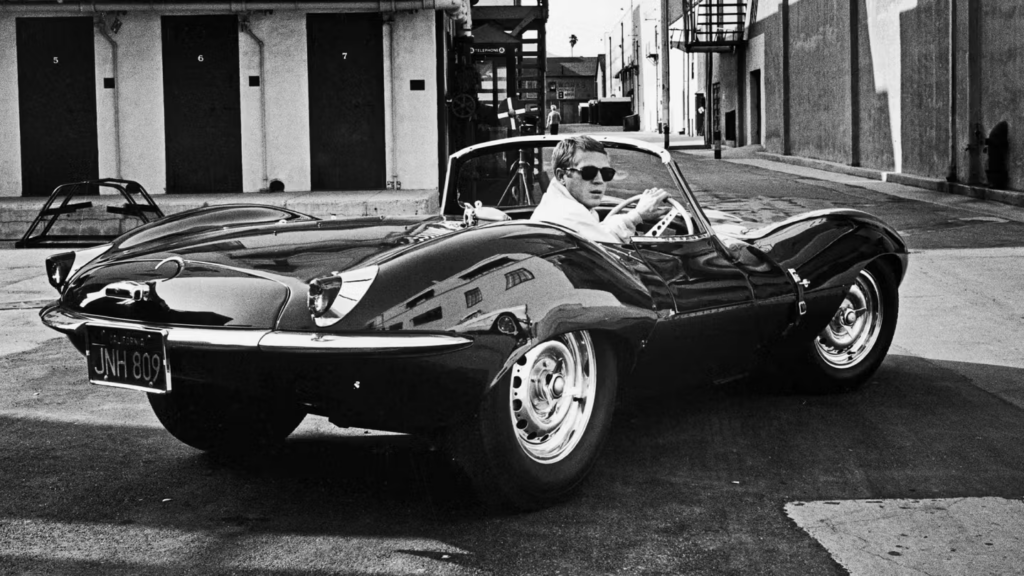
But beyond the glare of the Hollywood spotlights, McQueen’s true passion lay with machines. He was a gearhead in the truest sense of the word, a man who understood the soul of an engine and the ballet of a well-timed downshift. His love for cars and motorcycles wasn’t a marketing gimmick; it was a fundamental part of who he was. From the bikes he rode in The Great Escape to the dune buggy he helmed in The Thomas Crown Affair, McQueen brought an authentic, visceral connection to the vehicles in his films.
The Art of the Chase: From Silver Screen to Midnight Streets
For car enthusiasts, two films stand out as pinnacles of McQueen’s automotive obsession: Bullitt (1968) and Le Mans (1971). The iconic San Francisco chase scene in Bullitt, featuring Lt. Frank Bullitt’s Highland Green Mustang pursuit, is etched into the annals of cinematic history. McQueen drove the Mustang himself in all but the most dangerous sequences, imbuing the chase with a raw, terrifying realism that has never been replicated.
Le Mans, however, was a deeper, more personal project. McQueen intended to capture the raw emotion and brutal reality of endurance racing, spending months immersed in the world of motorsport. He drove the Gulf-liveried Porsche 917 at the very edge of its capabilities, pushing himself and the machine to their limits. The film, while a commercial disappointment at the time, has since become a cult classic, a testament to McQueen’s unwavering commitment to authenticity.
His participation in the 1970 Sebring 12-hour enduro further cemented his status as a legitimate racer. Teaming with Peter Revson in a Porsche 908/2, McQueen, even with a foot in a cast from a motorcycle accident, clawed his way up the leaderboard. It took a flying Mario Andretti in a Ferrari 512 to finally overtake them, but McQueen and Revson’s second-place finish spoke volumes about his talent and determination.
The Birth of a Legend: From Racing Pedigree to Street Machine
McQueen’s early automotive life was filled with the typical vices of a young, successful actor: MGs, a Lotus 11, a 289 Cobra, and various Ferraris. But as his career and fortune grew, so did his appetite for more exotic machinery. He amassed a collection that would make any modern-day billionaire jealous: Porsches, Packards, and eventually, the crown jewel, a 1957 Jaguar XKSS.
To understand the significance of this particular car, we must first look at its lineage. The Jaguar D-Type, the racing predecessor to the XKSS, was a masterpiece of 1950s engineering. Designed by Malcolm Sayer and William Lyons, the D-Type was a perfect marriage of form and function. Its monocoque chassis, advanced for the time, housed Jaguar’s legendary XK DOHC inline-six engine, producing around 250 horsepower in its initial configuration.
But the D-Type was a purebred racer, designed for the unforgiving circuits of Le Mans and Sebring. As the 1950s drew to a close, the car began to show its age. Stricter regulations and the emergence of more powerful competitors rendered the D-Type obsolete on the track. Jaguar, finding itself with a surplus of unsold customer cars, made a fateful decision: convert them for street use and sell them as limited-edition GTs.
Thus, the XKSS was born. The racing fin was removed, replaced by a vestigial luggage rack. A full-width windscreen, side curtains, and a rudimentary exhaust system were added. Two upholstered seats, a passenger door, and bumperettes completed the transformation. It was a compromise, but a beautiful one. Jaguar built just 16 XKSS models, making them exceedingly rare even before McQueen laid eyes on one.
XKSS.713: A California Love Affair
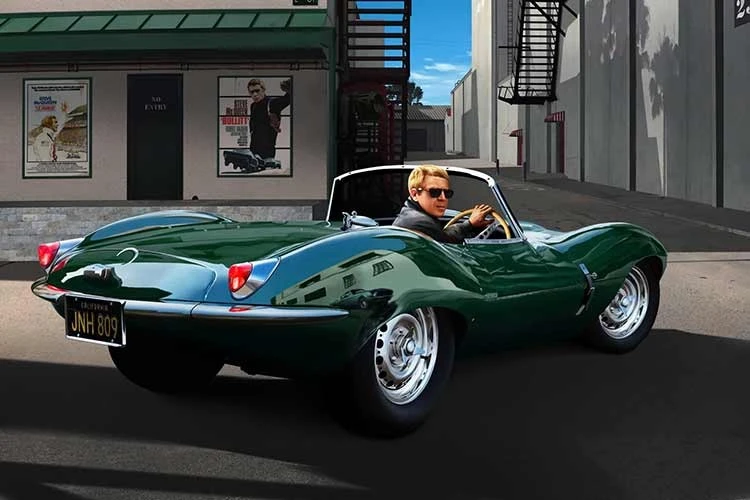
Jaguar Cars North America imported chassis number XK.SS.713 in April 1957. Despite its left-hand-drive destination, it arrived as a right-hand-drive model, a curiosity that only adds to its mystique. Its first owner was James Peterson, a building contractor involved in the construction of Riverside International Raceway. He soon sold the car to Bill Leyden, a local radio/TV personality who famously parked it on a studio lot on Sunset Boulevard in Hollywood.
It was here, amidst the glitz and glamour of 1950s Hollywood, that Steve McQueen first encountered the XKSS. Accounts vary on the exact year, but most agree that he purchased the car in 1958 for a sum in the ballpark of $4,000. Whether he saw it gleaming under the California sun or heard its distinctive exhaust echoing through the hills, the connection was immediate and profound.
McQueen wasted no time in making the car his own. He repainted the exterior a more subdued British Racing Green, though some speculate the color change happened later. The interior was reupholstered in black leather by none other than Tony Nancy, a legendary SoCal drag racer and upholsterer. Perhaps the most iconic modification was the metal glovebox door added by pinstriper Von Dutch, designed to prevent McQueen’s sunglasses from flying out during spirited drives.
The Green Rat, as he affectionately called it, became an extension of McQueen himself. He was often photographed working on the car, his hands greasy, his brow furrowed in concentration. This wasn’t a showpiece to be admired from a distance; it was a tool, a companion, a confidant.
Mulholland Drive: Where Legends Are Made
The true soul of the Green Rat was revealed on the winding, treacherous roads of Mulholland Drive. Running along the crest of the Hollywood Hills, this legendary stretch of pavement was McQueen’s playground. Between the hours of midnight and 4 a.m., when the city slept, he and a select group of friends would unleash their machines upon the curves.
Mulholland was far from perfect. The pavement was worn and patched, the shoulders nonexistent, and the proximity to residential homes unforgiving. But for McQueen, this was the ultimate test. He would navigate the serpentine road with a surgeon’s precision, his Jaguar snaking through the corners, its exhaust note a primal scream against the canyon walls.
Dick Messer, director of the Petersen Automotive Museum and one of the car’s caretakers, remembers those days vividly. “I remember him driving this car a lot,” Messer recalls. “People who lived up in the Hollywood Hills would hear the Jag coming and say, ‘Yep, there goes McQueen.’ The Jag was his favorite.”
To drive the XKSS on Mulholland today is to step directly into that legend. Squeezing into the compact cockpit is a challenge, even for someone of average size. Tony Nancy’s leatherwork has developed a rich patina over the decades, the years of use and abuse evident in every stitch. The wood-rimmed steering wheel sits close to the chest, the large Smiths gauges staring back like the eyes of a predator.
The Experience: Raw, Unfiltered, and Utterly Addictive
The starter motor grinds against the XK’s formidable 12.